Case study 02
A Respectful Remote Workplace
Scenario-based course where learners practice recognizing and responding to discrimination, harassment, and retaliation in a remote workplace.
Project Context
This project was created in response to the October 2026 Design Challenge from the eLearning Designer’s Academy: “Rescue this AI-generated compliance course.” The challenge provided the starting point, and I designed and developed my own learning solution.
I created a fictional remote technology company, Bostonian AI Journey, to give learners a consistent workplace setting for practicing how to recognize and respond to workplace concerns.
Challenge
Employees need to recognize potential discrimination, harassment, and retaliation in everyday workplace interactions. In a remote environment, these concerns may appear in team chats, video meetings, training decisions, and project assignments.
I wanted the experience to go beyond explaining policies and give learners opportunities to practice what they would say, which facts they would report, and when they would seek help.
My Role and Tools
Role: Learning Experience Designer
Tools: ChatGPT, Claude Design
I designed and developed the learning experience, including the course structure, characters, scenarios, assessment, feedback, visual design, navigation, and progress tracking. I also created the fictional company branding and a Quick Guide to support learners throughout the course.
Design Approach
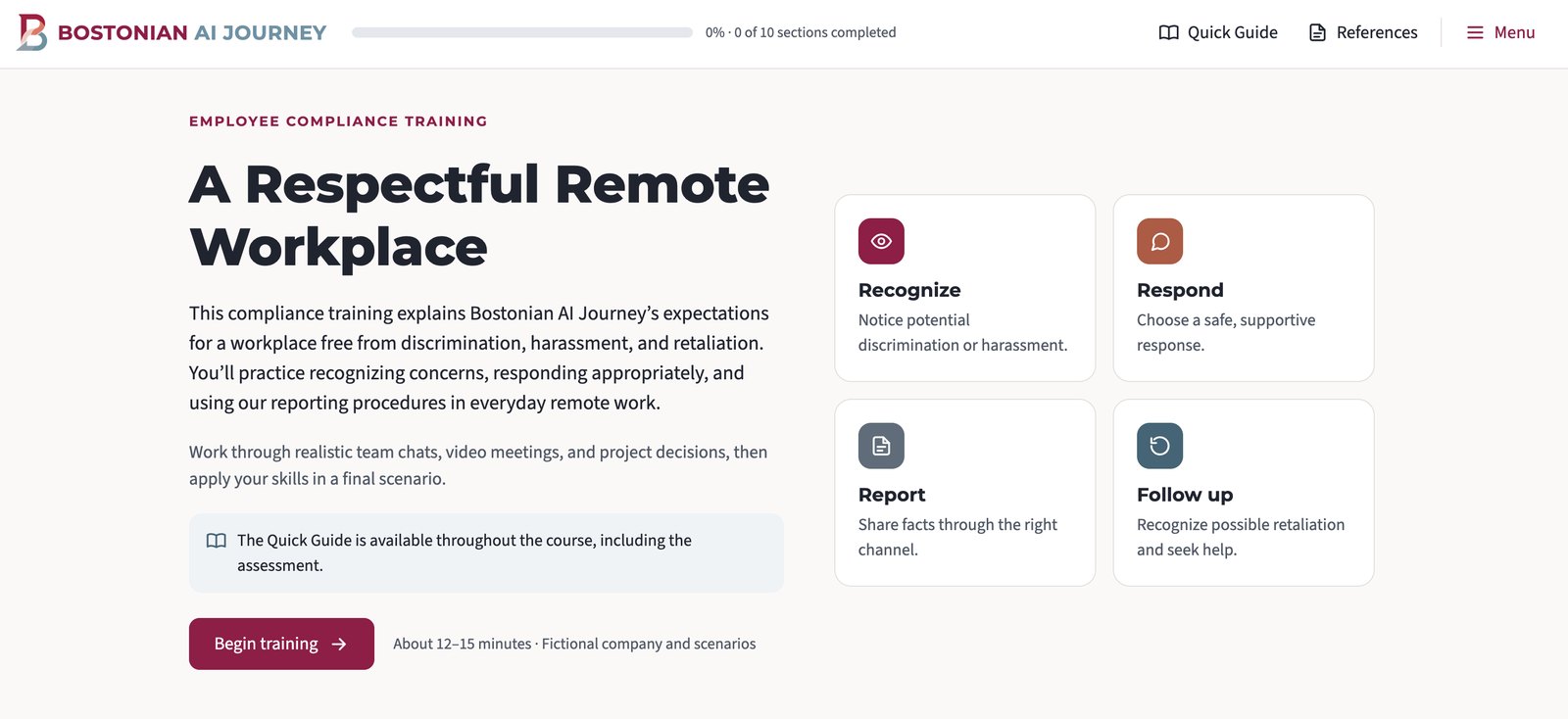
I organized the experience around four practical actions: Recognize, Respond, Report, and Follow up.
Learners take the role of a coworker on a remote product team. They follow a connected story about Maya, a machine learning engineer whose accent becomes the subject of comments and decisions about who presents her work.
Through simulated messages, meeting transcripts, and project records, learners decide how to support Maya, identify relevant facts, use reporting procedures, and respond to possible retaliation.
Practice activities provide feedback and opportunities to explore other responses. Learners then apply the same four skills in a new assessment scenario involving Sam, whose age affects access to job-related training.
The focus is on taking appropriate action within a coworker’s role. Learners recognize concerns and use the reporting process without being asked to investigate or determine whether a law has been broken.
Solution
I developed a custom interactive course set within a simulated remote workspace.
The final learning experience includes:
- A connected workplace story with realistic decision points
- Simulated team chats, meeting transcripts, and project updates
- Choice-specific responses and explanatory feedback
- A report-building activity that separates facts from assumptions
- Practice choosing an appropriate reporting channel
- A final assessment covering four practical skills
- New retry situations for skills learners need to practice again
- A Quick Guide available throughout the course and assessment
- A progress bar and a right-side pop-up content menu
Design Highlights
A Connected Workplace Story
Maya’s situation develops across several interactions, allowing learners to see how comments, work decisions, and later treatment can connect. Each decision builds on the context learners have already explored.
Practice with Feedback
Learners choose how to respond during private conversations and team meetings. Their choices produce different replies and feedback that explain the implications of each response.
Practice allows learners to explore alternatives and continue without requiring a correct answer at every step.
Building a Factual Report
Learners select statements to include in a practice report and see a live preview of their selections. The activity helps them distinguish direct observations, documented changes, and clearly attributed information from rumors and assumptions.
Assessment in a New Context
The final assessment introduces Sam’s situation rather than repeating Maya’s story. Learners demonstrate how to recognize a concern, respond supportively, report relevant facts, and follow up on possible retaliation.
Skills that need further practice are revisited through new situations.
Support at the Point of Need
The Quick Guide remains available throughout the experience, including during the assessment. It reinforces the four actions and provides the fictional company’s reporting options.
The progress bar and content menu help learners understand where they are, revisit completed sections, and see what comes next.
Screenshots
Simulated workspace: Maya’s message introduces the concern and asks learners to choose an initial response. Report-building activity: Learners select relevant facts and review their practice report. Final assessment: Sam’s scenario asks learners to apply the four skills in a different workplace situation.
Project Credit
Created in response to the October 2026 Design Challenge by the eLearning Designer’s Academy. I designed the course structure, fictional workplace, scenarios, assessment, interactions, and visual design, using ChatGPT and Claude Design to support the design and development process. Content references included EEOC resources and guidance on retaliation from Indeed.
Contact
I'm open to Learning Experience Designer roles. Feel free to reach out.